Caring Theory
Students learn under the Caring Theory as developed by Nel Noddings, formerly with Stanford. Caring Theory holds that the one caring develops relationships with the one cared for, our students so that their needs are attended to. Students are given the support to help them excel.
For example, at the beginning of the school year, all students admitted to AHA begin with an empirically based assessment for reading and math. Moreover, students are scheduled to take our assessments again at various points in the year to further track learning gains and progress. Administration and faculty analyze these data to drive instruction beginning early in the school year.
Furthermore, AHA partners with our parents as one of our most valued stakeholders. This partnership ensures that AHA goals and standards for each child is supported by each teacher and administrator at school, and in the home. Our partnership with parents also requires that we engage in regular meaningful communication with parents throughout the school year that is designed to help students flourish.
Giving students the support they need to excel.




Competency & Project-Based Learning
Our curriculum is tailored to give students the opportunity to demonstrate learning using various modalities. We teach students test taking skills, but formal assessments are much broader. Hence, while we follow state standards, we allow students to explore projects to demonstrate that they understand concepts.
Example of Project Based Learning
Soul Vibes Studio (SVS), a group of AHA pre-algebra students decided to work on a project where they first researched the length of songs and podcasts. SVS organized the data in function tables and then graphed them. This provided a framework to produce their podcast.
Next, students discussed the content of their story. They decided to focus on the increased number of teens needing mental health services to help youth cope with anxiety and depression. Moreover, the students divided up parts of the project. They regularly communicated and collaborated to update each other on the status of the various parts of the project.
SVS penned a poem with a positive message to encourage teens. To add an element of realism to their poem, the students created a protagonist, Lace to tell their story. The purpose of the poem was to encourage young people to hold onto their dreams and reach their golden hour — their time to shine. Students selected background music to play as they recited their poem and one of the students made an original hand drawn illustration.
Finally, SVS met with a professional podcaster to discuss how they could organize their poem with music and an image. After the meeting, students produced the podcast. The final podcast is below and was presented at the AHA Showcase Quarter III 2023.
Shortly after the podcast was completed, SVS took a Likert survey. The survey revealed that students were so engaged while producing the podcast that they would never forget this learning experience.
Running through a field with no thought in my mind
My hair in the wind
A luminous light in the sky
This dream that I’ve had is truly mine.
A young lady, Lace was hired for her dream job.
She had a lot of thoughts and emotions running through her head.
She was happy, excited and scared all at the same time.
So she decided to go somewhere where she could just clear her mind.
She went to a familiar grassy field that she had an emotional attachment to and ran freely through the field.
It’s my golden hour. I hope to shine.
Please slow down time
It’s my golden hour.
Music credit: Golden Hour, by JVKE
Hence, students experienced deeper learning by applying what they learned using project-based learning.

Real Stories
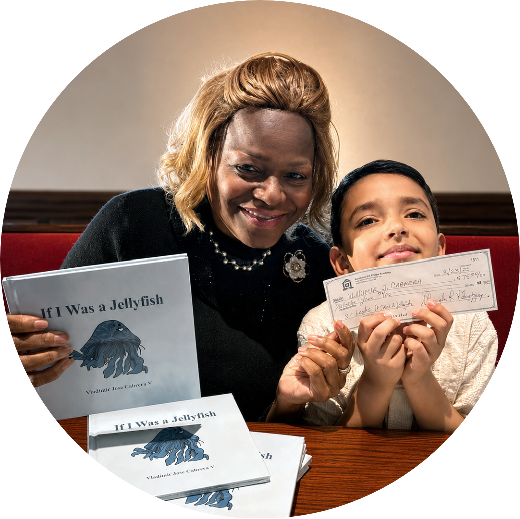
Publishing his first book
Vlad, 1st Grade
Vlad learned to read in kindergarten. He was ecstatic when he read his first book from cover to cover independently. Moreover, it was at that moment that he stated the ambitious goal that he was going to write his own book. And within one year, at 5 years old, Vlad authored and published his book: If I Was a Jellyfish.
Achievement Heights Academy
FAQ

Dr. N'Quavah R. Velazquez
Headmaster